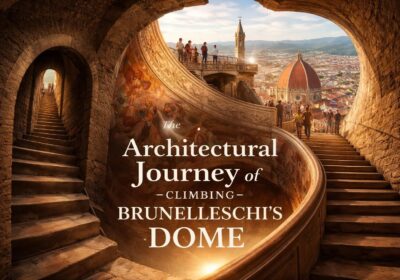


Explore the santa maria del fiore plan, revealing the architectural genius behind Florence's iconic cathedral and its groundbreaking design.
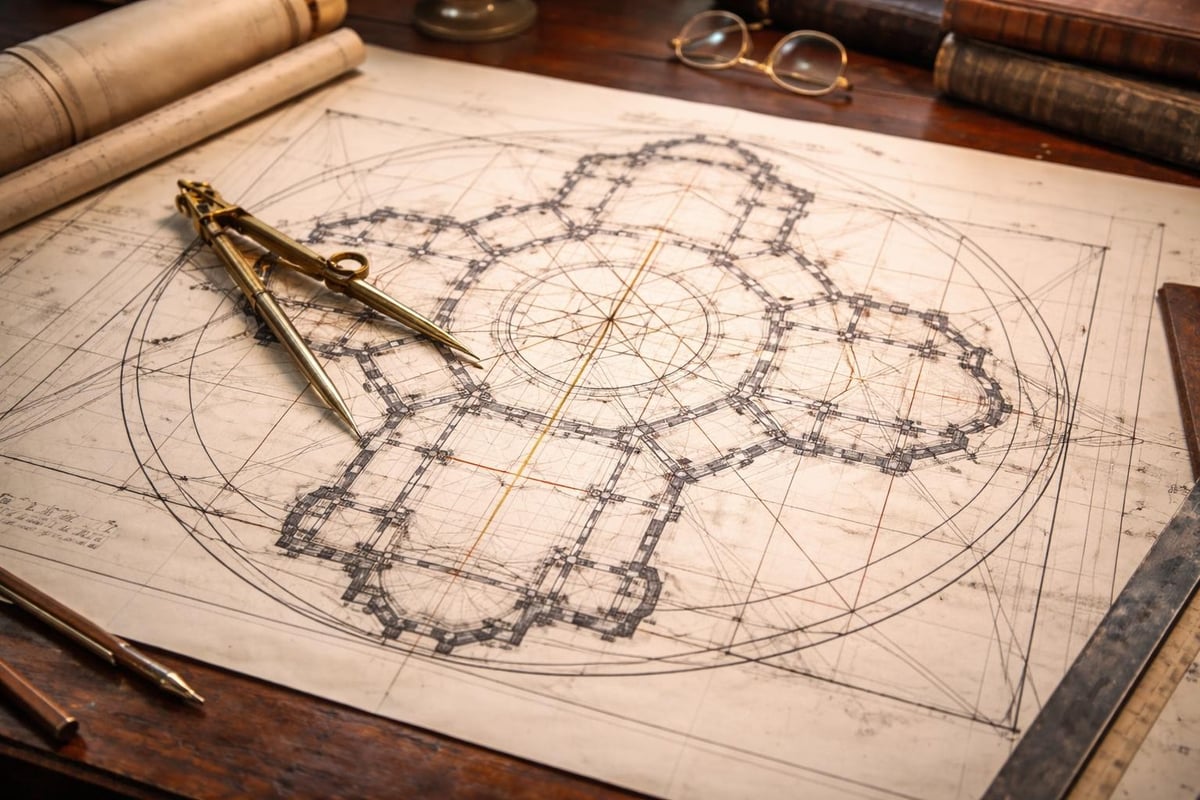
The architectural layout and structural planning of Santa Maria del Fiore cathedral, showing how Brunelleschi's dome, Giotto's campanile, and the main basilica integrate through mathematical precision and Renaissance design principles
The Original Vision and Early Design Phases
The santa maria del fiore plan began with the Florentine Republic's decision in 1296 to construct a cathedral worthy of the city's growing wealth and influence. Architect Arnolfo di Cambio received the commission to design a structure that would surpass the grandeur of rival cities like Pisa and Siena.
Di Cambio's initial vision called for a massive basilica with three broad naves converging at an octagonal crossing. This crossing would eventually support the cathedral's defining feature: a dome larger than any constructed since antiquity. The Cathedral of Santa Maria del Fiore’s architectural history reflects the evolving ambitions of Florence as it transformed from a medieval commune into a Renaissance powerhouse.
Dimensional Planning and Spatial Considerations
The cathedral's ground plan measures approximately 153 meters in length, making it one of the largest churches in Italy. The nave reaches 38 meters in width, while the octagonal tribune spans an impressive 45.5 meters across.
Key dimensional elements include:
- Main nave length: 90 meters
- Total internal width: 38 meters
- Octagonal crossing diameter: 45.5 meters (internal)
- Tribune depth: 30 meters
- Side aisles width: 11 meters each
These proportions weren't arbitrary. Medieval architects employed precise mathematical ratios derived from sacred geometry, ensuring the structure embodied harmony and divine order. The santa maria del fiore plan utilized these principles to create spaces that inspired spiritual contemplation while accommodating thousands of worshippers.
Brunelleschi's Revolutionary Dome Design
When construction reached the octagonal drum in the early 15th century, Florence faced a significant engineering challenge. The santa maria del fiore plan called for a dome spanning 45.5 meters without the support of traditional wooden centering, which would have been prohibitively expensive and technically unfeasible at such scale.
Filippo Brunelleschi won the commission in 1418 with an innovative double-shell design. His plan featured two concentric domes: an inner shell providing structural support and an outer shell protecting against weather while creating the cathedral's distinctive silhouette. The construction of this Renaissance superdome took over a century to complete, representing unprecedented engineering achievement.
The Herringbone Brick Pattern
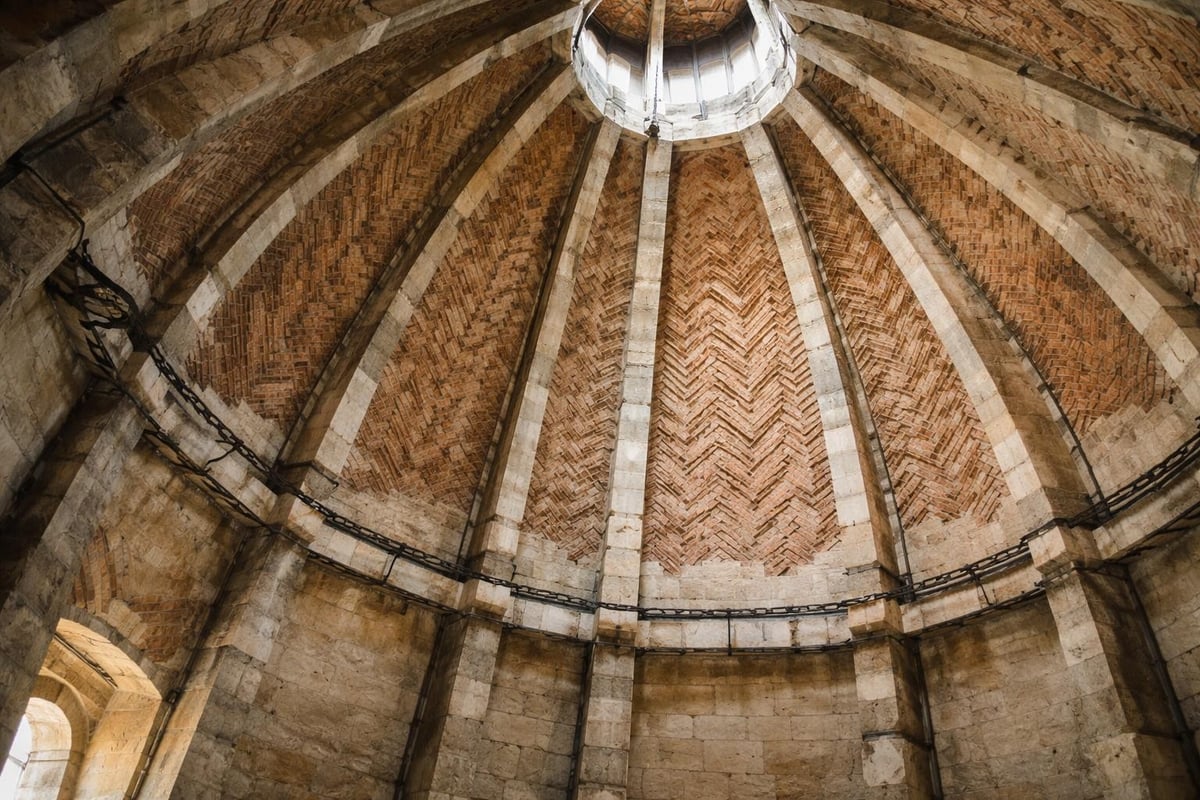
Brunelleschi's most ingenious contribution to the santa maria del fiore plan was his herringbone brick-laying pattern, known as spinapesce. This technique allowed bricks to support themselves during construction without temporary wooden supports.
| Feature | Specification | Purpose |
|---|---|---|
| Brick arrangement | Herringbone pattern | Self-supporting during construction |
| Shell thickness | 2.5 meters (base) to 1.2 meters (top) | Progressive weight reduction |
| Vertical ribs | 8 major, 16 minor | Structural reinforcement |
| Horizontal rings | Stone and wood chains | Contain lateral thrust |
The dome rises 114.5 meters from ground level, with the inner shell reaching 54 meters above the drum. Between the two shells, a network of staircases allows access to the lantern, providing modern visitors with reserved climbs that reveal Brunelleschi’s engineering genius firsthand.
The Campanile and Its Integration
While often considered separately, Giotto's Campanile formed an integral component of the overall santa maria del fiore plan. Begun in 1334 under Giotto di Bondone's direction, the bell tower stands 84.7 meters tall adjacent to the cathedral's facade.
Giotto's design harmonized with the cathedral through consistent use of polychrome marble panels in white, green, and pink. The tower's square plan measures 14.45 meters per side, with walls 3.6 meters thick at the base, tapering as they rise.
The campanile's five-level structure includes:
- First level with hexagonal relief panels depicting human activities
- Second level with diamond-shaped panels showing virtues and liberal arts
- Third through fifth levels with progressively larger windows
- Crown topped with Gothic pinnacles
This vertical emphasis complemented the dome's horizontal mass, creating visual balance in the santa maria del fiore plan. The tower's independent foundation also provided structural isolation, preventing settlement issues from affecting the main cathedral.

Nave and Aisle Configuration
The santa maria del fiore plan divides the cathedral's interior into a central nave flanked by two side aisles. This tripartite division follows traditional basilica layout while incorporating Gothic proportions and Renaissance refinement.
Structural Bay System
The nave comprises four major bays, each defined by massive compound piers supporting pointed arches. These piers measure approximately 5 meters in diameter, containing enough mass to resist the lateral thrust from the vaulted ceiling above.
The aisles feature ribbed cross vaults spanning between the outer walls and nave piers. This vaulting system distributes weight efficiently while creating rhythmic visual patterns that draw the eye toward the altar and dome.
| Space | Height | Width | Vaulting Type |
|---|---|---|---|
| Central nave | 45 meters | 16 meters | Ribbed cross vault |
| Side aisles | 23 meters | 11 meters | Ribbed cross vault |
| Transept arms | 45 meters | 16 meters | Ribbed cross vault |
| Octagonal tribune | 90 meters (to lantern) | 45.5 meters | Double-shell dome |
The architectural evolution documented by historians shows how successive architects refined these proportions to achieve optimal acoustics, lighting, and processional flow.
The Octagonal Tribune and Radiating Chapels
The heart of the santa maria del fiore plan is the octagonal tribune, where the nave, transepts, and choir converge beneath the dome. Each of the octagon's eight sides measures approximately 16.7 meters, creating a vast centralized space.
Five of the eight sides open into semicircular radiating chapels, each terminating in an apse. These chapels extend outward from the octagon, creating a flower-like pattern when viewed from above, which inspired the cathedral's dedication to "Santa Maria del Fiore" (Saint Mary of the Flower).
The three remaining sides connect to the nave and transept arms, maintaining axial alignment with the main entrance. This configuration allows natural light to flood the tribune from multiple directions while providing numerous altars for concurrent masses.
Chapel specifications:
- Diameter: 9 meters each
- Height: 28 meters to vault crown
- Windows: Three per chapel (original design)
- Altars: Dedicated to various saints and patrons
The santa maria del fiore plan's radiating chapel design influenced cathedral architecture throughout Tuscany and beyond, establishing a regional variant of Gothic spatial organization.
Facade Planning and Execution
The original santa maria del fiore plan included an elaborate facade, but Arnolfo di Cambio's incomplete front was demolished in 1587. The cathedral operated without a proper facade for nearly three centuries.
The current facade, completed in 1887, follows a 19th-century Neo-Gothic design by Emilio De Fabris. While not part of the original medieval plan, De Fabris carefully studied historical documents and coordinated his polychrome marble patterns with the campanile and baptistery.
Material Palette and Decorative Scheme
The facade employs three marble types quarried from Tuscany:
- White Carrara marble: Primary structural and decorative elements
- Green Prato marble: Decorative bands and geometric patterns
- Pink Maremma marble: Accent details and sculptural backgrounds
This tricolor scheme unifies the cathedral complex visually. The facade rises 55 meters, organized into three gabled sections corresponding to the interior nave and aisles. Sculptural programs depict the Virgin Mary, apostles, and Florentine saints across multiple registers.
Foundation and Structural Engineering
The santa maria del fiore plan required unprecedented foundation work to support the cathedral's massive weight. Medieval engineers excavated to bedrock in some areas while using massive stone foundations where bedrock lay too deep.
The octagonal drum supporting Brunelleschi's dome sits on foundations 7 meters deep and 13 meters wide. These foundations incorporate large stone blocks set in lime mortar, creating a rigid platform capable of bearing the dome's estimated 37,000-ton weight.
Foundation challenges included:
- Variable soil conditions across the building site
- Proximity to existing structures and streets
- Water table management in Florence's alluvial plain
- Integration with earlier structures, including the old cathedral
Recent archaeological investigations have revealed sophisticated drainage systems and foundation techniques that ensure stability even during Florence's occasional seismic activity.
Lighting Strategy and Window Placement
The santa maria del fiore plan incorporated sophisticated lighting design to create appropriate atmospheric conditions for worship. The cathedral features multiple window types strategically positioned throughout the structure.
The clerestory windows along the nave admit direct sunlight from approximately 23 meters above floor level. These windows employ simple geometric tracery, prioritizing light transmission over decorative complexity. The side aisle windows sit lower, providing softer illumination that contrasts with the bright clerestory.
The Dome's Ocular Windows
Eight circular windows pierce the drum beneath the dome, aligned with the octagon's corners. These windows, designed by various artists including Donatello and Lorenzo Ghiberti, contain stained glass depicting saints and biblical scenes.
The lantern atop the dome features eight additional windows, admitting zenithal light that illuminates the vast interior fresco "The Last Judgment" by Giorgio Vasari and Federico Zuccari.
| Window Type | Quantity | Location | Primary Function |
|---|---|---|---|
| Clerestory | 16 | Nave upper walls | Direct illumination |
| Aisle windows | 32 | Side aisle walls | Ambient light |
| Drum oculi | 8 | Octagonal drum | Tribune lighting |
| Lantern windows | 8 | Dome lantern | Overhead illumination |
| Facade rose | 1 | West facade | Evening light |
This layered approach to lighting creates dramatic effects throughout the day, supporting liturgical functions while enhancing the architectural experience.
Acoustic Considerations in the Plan
The santa maria del fiore plan