
Inside the Duomo Firenze: What to See in 2026

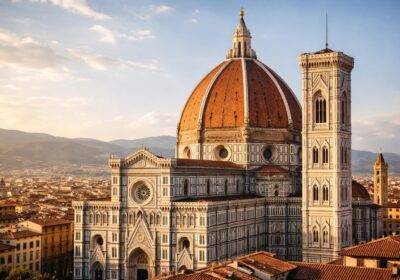
The duomo firenze inside reveals one of the world's most breathtaking sacred spaces, where Renaissance artistry meets medieval grandeur beneath the iconic dome designed by Filippo Brunelleschi. Walking through the massive bronze doors of the Basilica di Santa Maria del Fiore transports visitors into a vast interior that spans 153 meters in length, creating an immediate sense of awe that has captivated travelers for six centuries. Unlike the ornate exterior with its pink, white, and green marble facade, the cathedral's interior presents a more austere beauty that allows architectural mastery and select artistic treasures to command attention. This comprehensive guide explores every element worth discovering inside Florence's crown jewel, from the intricate floor designs to the mesmerizing dome frescoes that tower 90 meters above.
The Architectural Marvel Beneath Brunelleschi's Dome
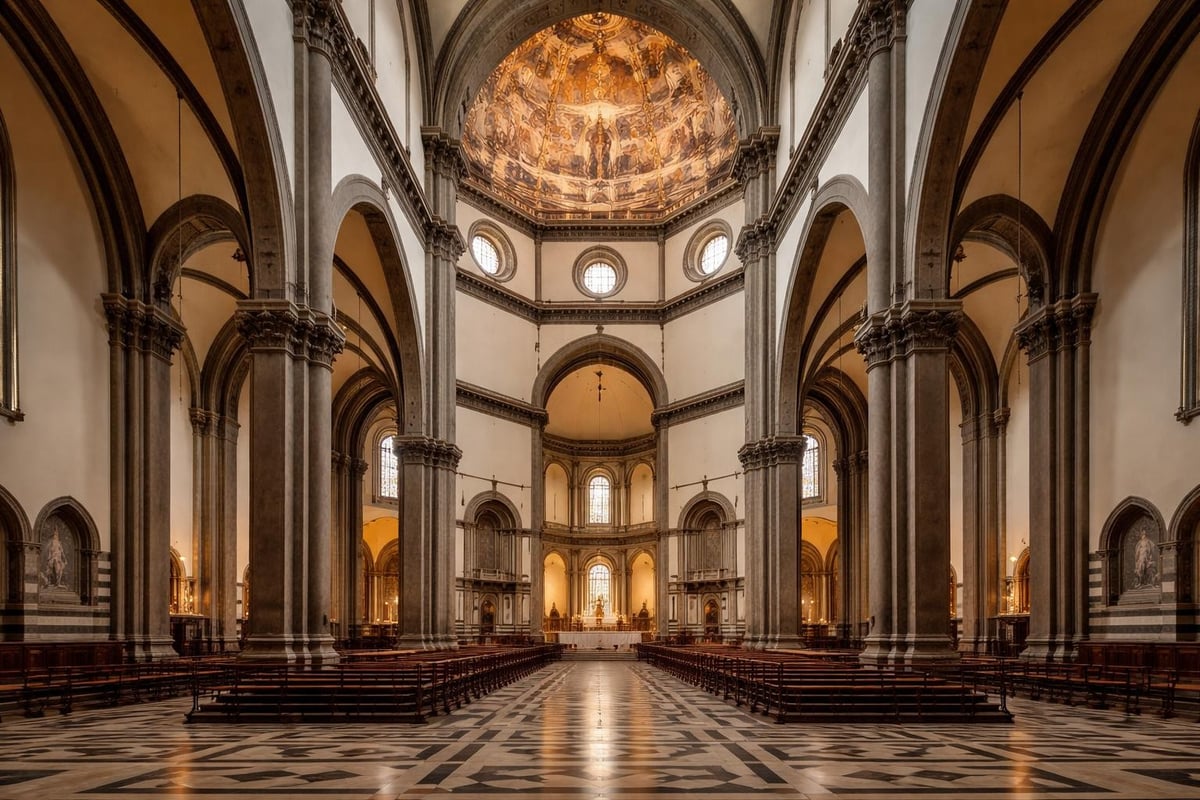
The first impression when stepping inside the Duomo di Firenze centers on the sheer scale of the Gothic interior space. The nave extends across three aisles supported by massive pillars, creating a floor plan that accommodates up to 30,000 people during major religious ceremonies. This architectural achievement represents the culmination of medieval church design in Tuscany.
The cathedral's interior dimensions include:
- Total length: 153 meters (502 feet)
- Width at the transept: 90 meters (295 feet)
- Height to the dome's apex: 90 meters (295 feet)
- Nave width: 38 meters (125 feet)
The duomo firenze inside showcases a deliberate contrast with other Italian cathedrals. Where Milan's Duomo overwhelms with Gothic ornamentation and St. Peter's dazzles with Baroque splendor, Florence's cathedral interior maintains a restrained elegance. The relatively plain walls draw eyes upward toward the dome, creating a vertical spiritual experience that Brunelleschi intended.
The Geometric Floor Pattern
The marble floor represents an often-overlooked masterpiece inside the cathedral. Completed over several centuries, the intricate geometric designs use the same color scheme as the exterior: white Carrara marble, green Prato marble, and pink Maremma marble. These patterns create visual pathways that guide visitors through the sacred space while serving a practical function during the Renaissance period when pews were uncommon.
The floor's most significant feature appears at the cathedral's entrance, where a 1475 marble design by Baccio d'Agnolo marks the spot where the original facade stood before its 19th-century reconstruction. Walking along these marble pathways allows visitors to appreciate how Renaissance architects used flooring as both functional art and spatial organization.
Vasari's Last Judgment Frescoes
The duomo firenze inside reaches its artistic zenith in the dome frescoes that cover 3,600 square meters of surface area. Giorgio Vasari began this monumental project in 1572, depicting the Last Judgment across eight segments corresponding to the octagonal dome structure. After Vasari's death in 1574, Federico Zuccari completed the work in 1579, maintaining stylistic continuity while adding his interpretations.
| Fresco Section | Theme Depicted | Notable Features |
|---|---|---|
| Eastern segment | Christ in Glory | Central figure of judgment |
| Northeastern | The Blessed | Angels and saved souls |
| Northern | Prophets and Sibyls | Old Testament figures |
| Northwestern | Virtues | Allegorical representations |
| Western | The Damned | Souls in torment |
| Southwestern | Hell's Punishments | Dante-inspired imagery |
| Southern | Resurrection | Bodies rising from graves |
| Southeastern | Angels with Instruments | Musical celebration |
Viewing these frescoes properly requires understanding their placement. The cathedral’s design positions viewers at ground level, creating dramatic foreshortening effects that Renaissance artists mastered. The figures appear correctly proportioned only when viewed from the floor, demonstrating the mathematical precision Vasari and Zuccari employed.
The color palette inside the dome contrasts sharply with the austere walls below. Rich blues, vibrant reds, and luminous golds create a celestial atmosphere meant to inspire contemplation of divine judgment. This artistic choice reflects Counter-Reformation theology, which emphasized dramatic visual narratives to communicate religious doctrine to largely illiterate congregations.
The Cathedral's Artistic Treasures
Beyond the dome frescoes, the duomo firenze inside contains carefully curated artworks that survived various historical purges and renovations. The cathedral underwent significant remodeling in the 16th century when Medici Grand Duke Francesco I ordered removal of many medieval elements to achieve a more unified aesthetic vision.
Notable Artworks Inside the Cathedral
Paolo Uccello's Frescoes:
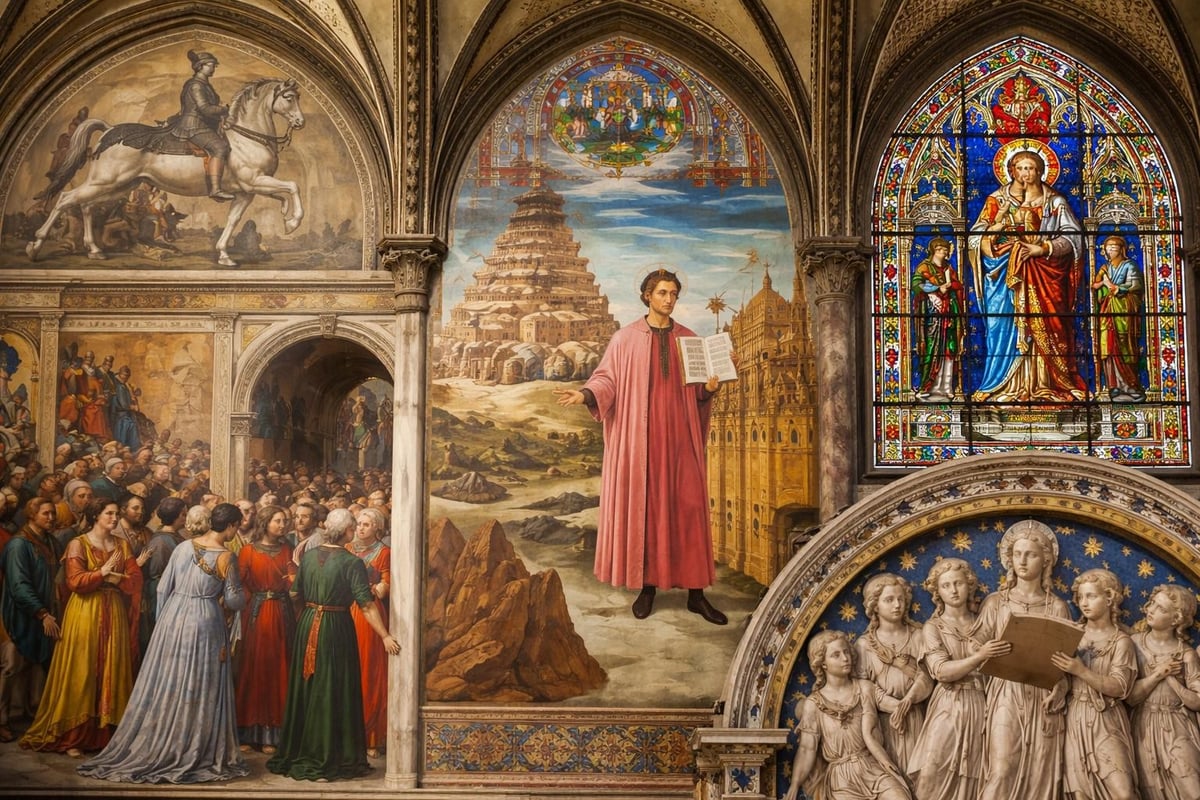
The cathedral's walls feature two monochromatic frescoes by Paolo Uccello depicting equestrian monuments. These 1436 works honor condottieri (mercenary leaders) John Hawkwood and Niccolò da Tolentino, creating the illusion of three-dimensional statues through masterful perspective techniques.
Domenico di Michelino's Dante and the Divine Comedy:
Located on the nave's north wall, this 1465 painting shows Dante Alighieri holding his epic poem, with Florence, Purgatory, and Paradise depicted in the background. The artwork commemorates Dante's contributions to Italian literature and his complex relationship with Florence, which exiled him in 1302.
The Saqrestia Nuova Doorway:
Luca della Robbia created the lunette above the New Sacristy door, featuring a terracotta relief of the Resurrection. This glazed ceramic work demonstrates the technical mastery that made della Robbia workshop famous throughout Renaissance Italy.
Stained Glass Windows:
The cathedral features circular stained glass windows designed by renowned artists including Donatello, Andrea del Castagno, and Paolo Uccello. These windows filter light through biblical narratives, creating shifting color patterns across the marble floor throughout the day.
The Clock and Liturgical Calendar
The duomo firenze inside features an unusual 24-hour liturgical clock painted by Paolo Uccello in 1443. Located on the interior west wall above the main entrance, this clock runs counterclockwise using the hora italica system where the 24th hour coincides with sunset. This timekeeping method remained common in Italy until the 18th century.
The clock face displays four prophet heads at the corners and uses a single hand pointing to Roman numerals. Modern visitors often overlook this historical timepiece, but it represents sophisticated astronomical knowledge and liturgical time calculations that governed Renaissance daily life. Understanding Florence’s Gothic architecture reveals how such elements served both practical and symbolic functions.
The High Altar and Choir
The cathedral's high altar occupies the octagonal space directly beneath the dome, positioned at the spiritual heart of the building. The current marble altar dates from the 16th century and replaced earlier Gothic structures. During major liturgical celebrations, this area becomes the focal point for ceremonies led by the Archbishop of Florence.
Surrounding the altar, the choir stalls feature intricate wood inlays (intarsia) created by various Renaissance craftsmen. These stalls originally included works by Giuliano and Benedetto da Maiano, though many pieces now reside in the Museo dell'Opera del Duomo for preservation. The choir area underwent significant modifications during Counter-Reformation renovations aimed at improving acoustic properties and creating better sight lines for congregants.
The Underground Crypt and Archaeological Zone
Beneath the cathedral floor lies the archaeological excavation area revealing the church of Santa Reparata, which occupied this site from the 5th century until construction began on the current Duomo in 1296. The duomo firenze inside extends below ground, where visitors can explore these ancient foundations and view archaeological evidence of Florence's early Christian community.
Key features of the underground area include:
- Roman mosaics from residential buildings predating Christian structures
- Tomb of Filippo Brunelleschi, discovered in 1972
- Remnants of Santa Reparata's walls and column bases
- Medieval burial sites of prominent Florentine citizens
- Fragments of early Christian frescoes and decorative elements
This subterranean layer adds historical depth to the cathedral experience, demonstrating how Florentine builders constructed their Renaissance masterpiece atop centuries of previous sacred architecture. The excavation reveals construction techniques, burial practices, and material culture spanning nearly two millennia.
Visiting the Dome Interior: The Climb Experience
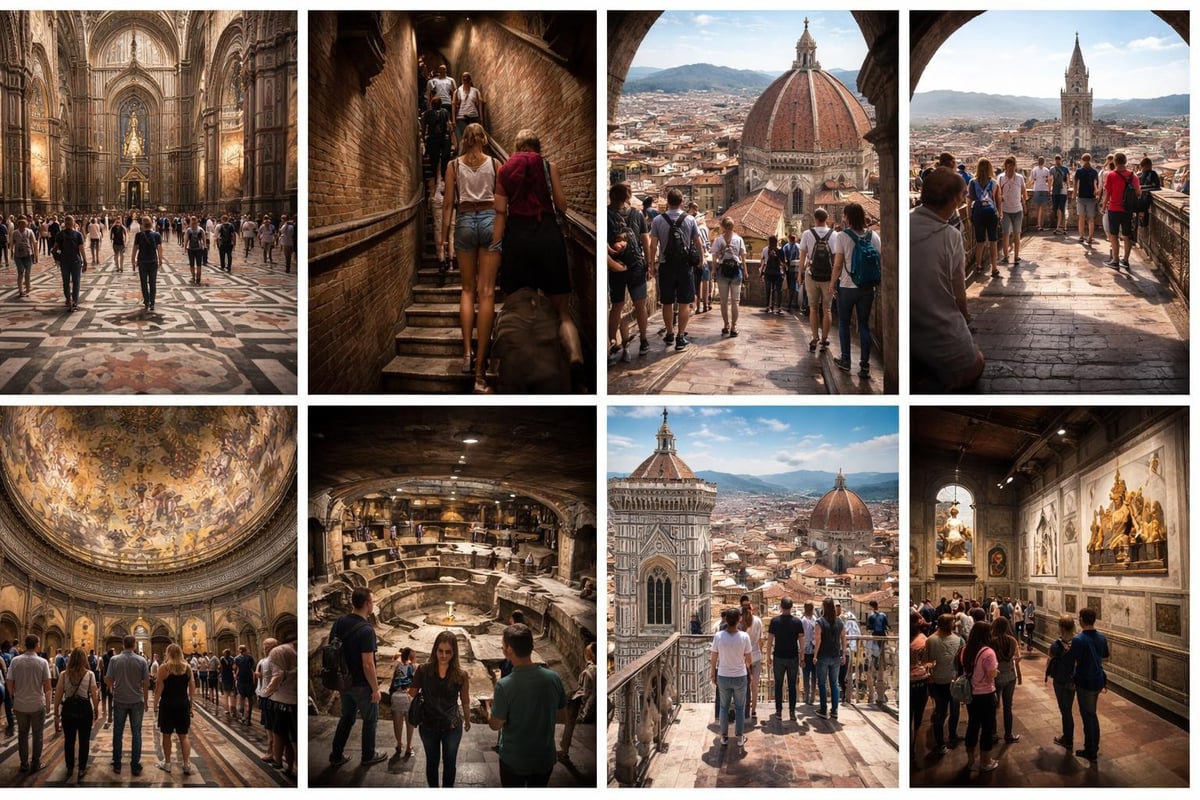
While technically separate from exploring the cathedral floor, climbing inside Brunelleschi's dome represents an essential part of experiencing the duomo firenze inside. The 463-step ascent takes visitors between the dome's double-shell construction, offering unprecedented close-up views of Vasari's frescoes and insight into Brunelleschi's revolutionary engineering.
| Climbing Aspect | Details |
|---|---|
| Total steps | 463 steps |
| Elevation gain | 85 meters (279 feet) |
| Passage width | Narrow, some only 46 cm |
| Average climb time | 45-60 minutes |
| Capacity limits | Small groups, timed entry required |
The climb route follows stairs built into the space between the inner and outer shells. Windows along the ascent provide resting points and perspectives on the frescoes impossible to achieve from the cathedral floor. The engineering genius becomes apparent as climbers observe how the herringbone brick pattern provides structural stability without requiring temporary wooden supports during construction.
At the lantern level, the viewing platform offers 360-degree panoramas across Florence, with the Arno River, Giotto’s Campanile, and surrounding Tuscan hills visible in all directions. This vantage point contextualizes how the dome dominates Florence's skyline and why Brunelleschi's achievement earned him lasting recognition as a Renaissance genius.
The Sacristies and Side Chapels
The cathedral includes two sacristies flanking the main apse, serving as preparation spaces for religious ceremonies. The Sagrestia Vecchia (Old Sacristy) features bronze doors by Luca della Robbia decorated with reliefs depicting the Virgin Mary, John the Baptist, and evangelists. The Sagrestia Nuova (New Sacristy) contains the intarsia doorway mentioned earlier.
Several side chapels punctuate the cathedral's perimeter, though far fewer than in medieval churches. This reflects the Renaissance preference for unified spatial design over fragmented chapel arrangements. The existing chapels contain altarpieces and devotional artwork, though many original pieces have been relocated to the Museo dell’Opera del Duomo for conservation.
Practical Visitor Information for 2026
Understanding how to experience the duomo firenze inside requires planning, as the cathedral implements timed entry and visitor management systems. The Duomo complex includes the cathedral itself, Brunelleschi's Dome, Giotto's Bell Tower, the Baptistery, and the museum-each requiring separate timed entries but covered under a unified ticket system.
Current visiting parameters:
- Cathedral floor visit: Free entry with timed reservation
- Dome climb: Requires advance ticket with specific time slot
- Combined complex ticket: Covers all five monuments
- Typical cathedral visit duration: 30-45 minutes
- Recommended total complex time: 3-4 hours minimum
Dress codes remain strictly enforced inside this active place of worship. Shoulders and knees must be covered, and security personnel turn away inappropriately dressed visitors regardless of ticket status. Photography is permitted inside the cathedral but prohibited during religious services, which take precedence over tourist access.
The best times to visit the duomo firenze inside are early morning immediately after opening or late afternoon before closing. Midday hours see peak crowding, particularly during summer months when Florence experiences maximum tourist traffic. Visiting Florence beyond tourist crowds requires strategic timing and advance planning.
The Duomo's Acoustic Properties
The cathedral's vast interior creates unique acoustic characteristics that influenced liturgical music development. The long reverberation time-approximately 8-10 seconds for mid-frequency sounds-presented challenges for polyphonic choral music that Renaissance composers addressed through specific compositional techniques.
Florence's cathedral choir commissioned works from leading composers who adapted their style to the building's acoustics. The placement of choir members and the use of antiphonal singing (alternating groups) helped create clarity despite extended sound decay. Modern concerts occasionally take place inside the cathedral, demonstrating how contemporary sound engineers work with these historical acoustic properties.
Conservation and Restoration Efforts
Maintaining the duomo firenze inside requires continuous conservation work addressing pollution damage, structural stress, and natural deterioration. Recent restoration projects have focused on cleaning the dome frescoes, consolidating fragile plaster areas, and monitoring structural stability using advanced sensors and imaging technology.
The cathedral's marble floor undergoes periodic cleaning and repair to address wear patterns from millions of annual visitors. Conservation teams use traditional materials and techniques to match historical construction methods while incorporating modern preventive measures. This balance between preservation and accessibility defines contemporary heritage management at Florence's most visited monument.
The Duomo’s historical significance extends beyond architectural achievement to represent Florence's Renaissance identity and ongoing commitment to cultural stewardship. The building functions simultaneously as active cathedral, museum, engineering marvel, and civic symbol-roles that sometimes create competing demands on space and access.
Comparing the Interior to Other Italian Cathedrals
The duomo firenze inside occupies a unique position among Italy's great churches. Unlike the overwhelming decoration of Venice's San Marco or the Baroque exuberance of Rome's St. Peter's, Florence's cathedral interior demonstrates Renaissance restraint and mathematical proportion. This aesthetic philosophy reflects Florentine intellectual culture, which valued classical harmony and geometric order.
Cathedral Interior Comparison:
| Cathedral | Interior Style | Length | Notable Features |
|---|---|---|---|
| Florence Duomo | Gothic-Renaissance | 153m | Vasari frescoes, geometric floor |
| Milan Duomo | Gothic | 158m | Dense ornamentation, 52 columns |
| St. Peter's Rome | Baroque | 186m | Michelangelo's dome, Bernini's baldachin |
| Siena Duomo | Gothic | 89m | Striped marble, Piccolomini Library |
The austere quality inside Florence's cathedral allowed Brunelleschi's dome to dominate the spatial experience. Comprehensive guides to the Duomo emphasize how this design choice created unity between architecture and decoration, avoiding the visual competition found in more ornately decorated churches.
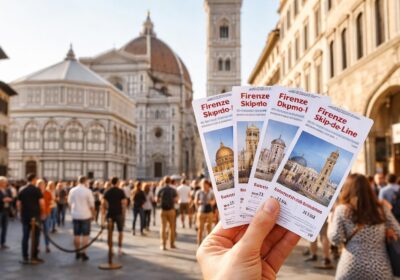
Experiencing the duomo firenze inside reveals layers of artistic achievement, architectural innovation, and spiritual significance that have defined Florence since the Renaissance. From Vasari's dramatic frescoes to the geometric floor patterns and underground archaeological treasures, every element contributes to understanding why this cathedral remains central to Florence's cultural identity. EU Tours specializes in skip-the-line tickets and expert-guided experiences that help visitors maximize their time inside the Duomo complex, ensuring you don't miss the details that make this monument truly extraordinary while avoiding the lengthy queues that can consume hours of your Florence visit.